Jump-starting mistakes to avoid with a dead battery
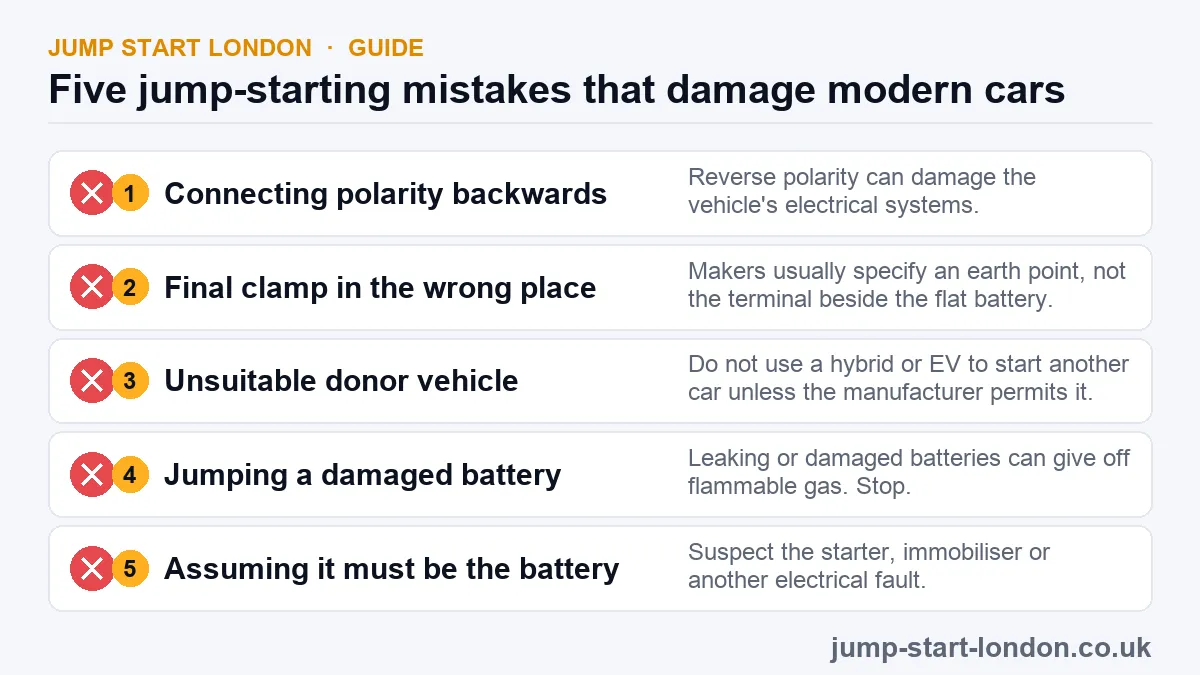
A dead car battery can often be jumpstarted, but doing it safely matters more than doing it quickly. The common mistakes are reversed polarity, the final clamp in the wrong place, a hybrid donor car and jumping a damaged battery.
A dead car battery can often be jumpstarted, but doing it safely matters more than doing it quickly.
This is particularly true with modern cars because a mistake that once resulted in a spark or blown fuse can now potentially affect expensive electronic systems.
The safest starting point
Open the owner's manual.
Find the manufacturer's jump-start instructions.
Identify the correct positive terminal and negative earth point before attaching anything.
Do not rely solely on where you think the battery should be. On some vehicles the battery is remotely mounted and dedicated jump terminals are provided elsewhere.
Common mistakes drivers make
Connecting polarity backwards
Positive and negative connections are not interchangeable.
Reverse polarity can damage vehicle electrical systems.
Attaching the final clamp in the wrong place
Manufacturer instructions frequently specify a designated earth point rather than attaching the final negative connection directly beside the discharged battery.
Using an unsuitable donor vehicle
Do not automatically use a hybrid or EV to start another car.
RAC advises avoiding this unless the manufacturer permits it.
Trying to jump a damaged battery
If the battery is leaking or physically damaged, stop.
AA guidance warns that batteries can produce flammable gases and that jump starting damaged batteries can be dangerous.
Assuming the battery must be the problem
A car that still refuses to start with adequate external power might have a starter, immobiliser or other electrical fault.
After the jump
Once the vehicle is running, resist the temptation to immediately switch it off.
The battery needs an opportunity to recover.
The AA recommends around 30 minutes of normal driving rather than stop-start traffic following a successful jump start, while a suitable battery charger can be used to restore charge more fully.
If it happens again
A second unexplained flat battery should change your strategy.
Instead of repeatedly asking:
"How can I jumpstart it again?"
ask:
"Why is the battery losing charge?"
Have the following investigated:
- battery condition
- alternator/charging output
- battery terminals
- parasitic current drain
- vehicle electrical faults
That is the difference between roadside recovery and actually fixing the problem.
Bottom line
You can often jumpstart a dead battery when the problem is simply insufficient charge.
You should not jumpstart a visibly damaged battery, guess at connections or interfere with unfamiliar hybrid/high-voltage systems.
And once the vehicle starts, remember that the jump start was the rescue — not necessarily the repair.
Need this now?
Car jump start in London from £49, 24/7. Call for a price and a real arrival time, or get a quote.